

The cost of onboarding is higher than most teams realize.
Manuals, translations, custom apps, half-finished YouTube series — onboarding looks cheap until you scale it across a product line. A look at where the real cost lives, and the more practical solution most teams overlook.
BY CALLUM THOMAS →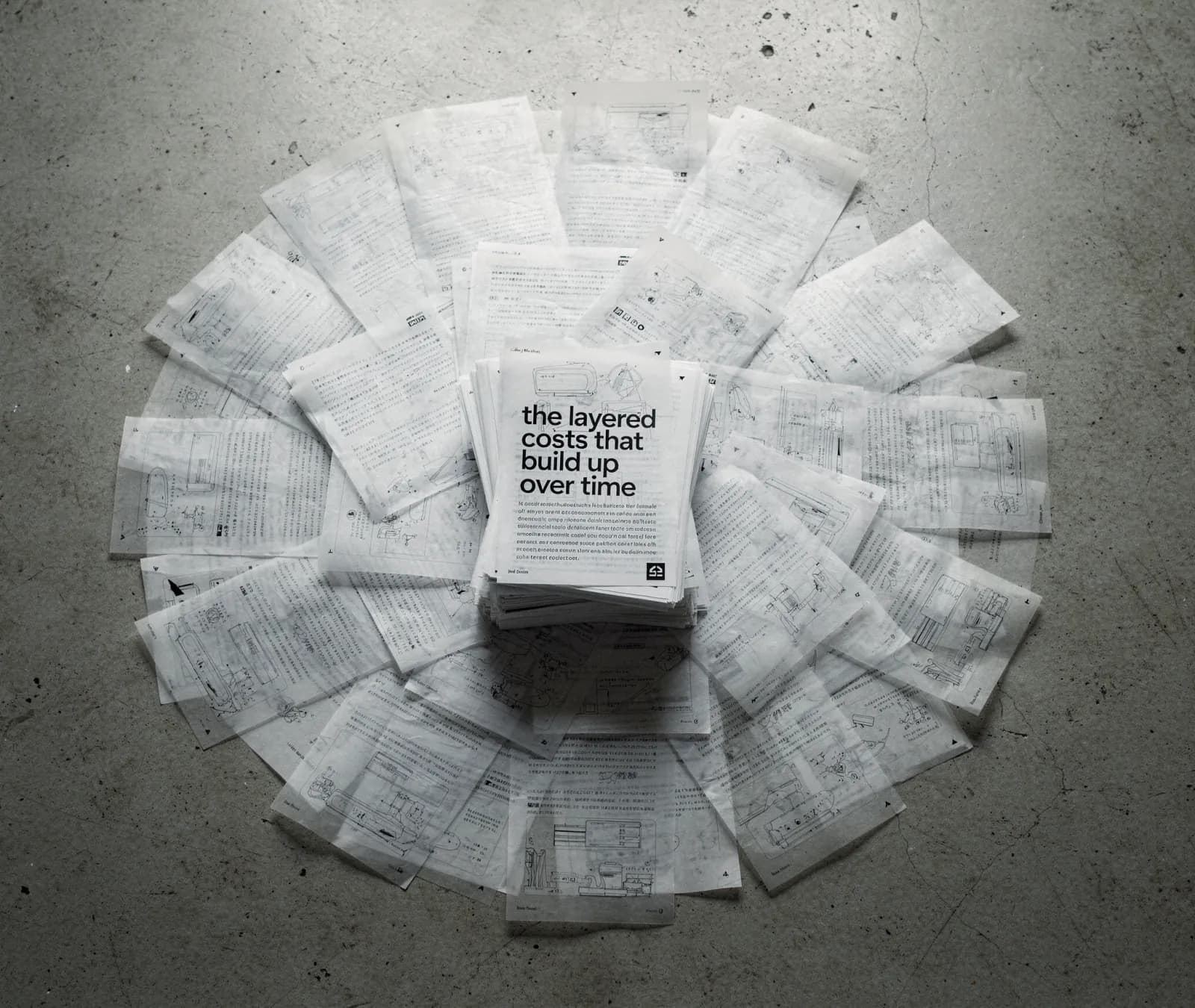
When companies think about onboarding, they usually think about experience.
Is it clear?
Is it helpful?
Does it reflect the brand?
What often gets less attention is the cost sitting behind all of that.
Not just the obvious costs — but the layered ones that build up over time.
It Starts With Something Simple
Take a typical physical product.
There's almost always some version of:
- A printed manual
- A quick-start guide in a dozen languages
On the surface, none of this feels particularly expensive. It's just part of the product.
But scale changes the math.
Designing those materials takes time. Translating them takes more. Printing, packaging, and updating them adds another layer. And once they're produced, they're fixed — locked in until the next run.
For a single product, it's manageable.
Across an entire product line, it becomes something else entirely.
Digital Was Supposed to Solve This
The natural response has been to move things online.
Replace the booklet with a QR code. Host a video. Build a help centre.
It does solve some problems. Updates become easier. Distribution is simpler.
But it introduces new ones.
Long-form videos — often hosted on platforms like YouTube — still require production, editing, and upkeep. And from a user's perspective, they're not always much easier to navigate. You're still searching, skipping, trying to find the right moment.
So while the format changes, the friction doesn't fully disappear.
The High-End Solution: Build Your Own Experience
At the other end of the spectrum are fully custom onboarding solutions.
Some brands invest heavily here:
- Interactive apps
- 3D-rendered product walkthroughs
- Custom-built onboarding flows
These can be impressive. In some cases, genuinely useful.
They're also expensive.
It's not unusual for these projects to run into the hundreds of thousands — sometimes closer to $500K by the time design, development, and deployment are complete.
And that's just the starting point.
They still need to be:
- Maintained
- Updated
- Supported internally
What begins as a customer experience initiative quickly becomes a long-term operational commitment.
A Pattern Starts to Emerge
If you step back, most onboarding approaches fall into a familiar pattern:
- Printed materials are straightforward, but rigid and ongoing in cost
- Basic digital content is flexible, but often underwhelming in experience
- Custom builds are powerful, but expensive and complex to sustain
Each option solves part of the problem, but introduces another.
Which is why many teams end up somewhere in the middle — never quite satisfied, but hesitant to invest further.
A More Practical Solution
What's starting to change is how companies think about the balance between cost and experience.
Instead of building everything themselves, some are moving toward platforms that handle both the delivery and the structure of onboarding — while allowing the brand to focus on the content itself.
That's where Webstory fits in.
Rather than treating onboarding as a one-off project, it treats it as an ongoing, manageable system:
- Short, visual walkthroughs
- Structured as a sequence rather than a single asset
- Designed for mobile, where most people actually engage
The difference isn't just in how it looks — it's in how it's maintained.
Reducing the Burden Behind the Scenes
One of the less visible advantages of this kind of approach is operational.
There's no need to:
- Reprint materials every time something changes
- Rebuild custom features for each product
- Maintain a dedicated app or platform internally
Content can be updated centrally and applied across products. The same structure can be reused, adapted, and scaled.
For teams managing multiple SKUs or frequent product iterations, that shift alone can make a significant difference.
And the Experience Doesn't Suffer
If anything, it improves.
Short, guided video steps — delivered in sequence — are often easier to follow than:
- A dense manual
- A long, linear video
They align more closely with how people already consume information on platforms like TikTok or Instagram — quick, visual, and progressive.
So the trade-off isn't really between cost and quality.
It's between how efficiently you can deliver both.
Rethinking Where the Investment Should Go
There's a tendency, especially in larger organizations, to assume that a better experience requires a larger build.
Sometimes that's true.
But in onboarding, the value often comes from clarity and timing — not complexity.
A well-paced, thoughtfully designed sequence of short steps can do more than a highly produced, expensive system that's harder to navigate.
And it does it without the same level of financial and operational overhead.
Closing Thought
Onboarding is one of those areas where small improvements are easy to overlook — but they compound quickly.
Every product shipped carries that experience with it. Every customer goes through it.
So the question isn't just how to make it better.
It's how to make it:
- Scalable
- Maintainable
- And aligned with how people actually engage today
Because in the end, the best onboarding experience isn't necessarily the most expensive one.
It's the one that works — consistently, clearly, and without creating more complexity behind the scenes than it solves.
